在目录下安装依赖
pip install -e .[gradio]
测试代码
import gradio as gr
import torch
from transformers import AutoConfig, AutoModelForCausalLM
from janus.models import MultiModalityCausalLM, VLChatProcessor
from janus.utils.io import load_pil_images
from PIL import Image

import numpy as np
import os
import time
# import spaces  # Import spaces for ZeroGPU compatibility

# Load model and processor
model_path = "/root/ai/Janus/Janus-Pro-1B"
config = AutoConfig.from_pretrained(model_path)
language_config = config.language_config
language_config._attn_implementation = 'eager'
vl_gpt = AutoModelForCausalLM.from_pretrained(model_path,
                                             language_config=language_config,
                                             trust_remote_code=True)
if torch.cuda.is_available():
    vl_gpt = vl_gpt.to(torch.bfloat16).cuda()
else:
    vl_gpt = vl_gpt.to(torch.float16)

vl_chat_processor = VLChatProcessor.from_pretrained(model_path)
tokenizer = vl_chat_processor.tokenizer
cuda_device = 'cuda' if torch.cuda.is_available() else 'cpu'

@torch.inference_mode()
# @spaces.GPU(duration=120)
# Multimodal Understanding function
def multimodal_understanding(image, question, seed, top_p, temperature):
    # Clear CUDA cache before generating
    torch.cuda.empty_cache()

    # set seed
    torch.manual_seed(seed)
    np.random.seed(seed)
    torch.cuda.manual_seed(seed)

    conversation = [
        {
            "role": "<|User|>",
            "content": f"<image_placeholder>\n{question}",
            "images": [image],
        },
        {"role": "<|Assistant|>", "content": ""},
    ]

    pil_images = [Image.fromarray(image)]
    prepare_inputs = vl_chat_processor(
        conversations=conversation, images=pil_images, force_batchify=True
    ).to(cuda_device, dtype=torch.bfloat16 if torch.cuda.is_available() else torch.float16)

    inputs_embeds = vl_gpt.prepare_inputs_embeds(**prepare_inputs)

    outputs = vl_gpt.language_model.generate(
        inputs_embeds=inputs_embeds,
        attention_mask=prepare_inputs.attention_mask,
        pad_token_id=tokenizer.eos_token_id,
        bos_token_id=tokenizer.bos_token_id,
        eos_token_id=tokenizer.eos_token_id,
        max_new_tokens=512,
        do_sample=False if temperature == 0 else True,
        use_cache=True,
        temperature=temperature,
        top_p=top_p,
    )

    answer = tokenizer.decode(outputs[0].cpu().tolist(), skip_special_tokens=True)
    return answer

def generate(input_ids,
             width,
             height,
             temperature: float = 1,
             parallel_size: int = 5,
             cfg_weight: float = 5,
             image_token_num_per_image: int = 576,
             patch_size: int = 16):
    # Clear CUDA cache before generating
    torch.cuda.empty_cache()

    tokens = torch.zeros((parallel_size * 2, len(input_ids)), dtype=torch.int).to(cuda_device)
    for i in range(parallel_size * 2):
        tokens[i, :] = input_ids
        if i % 2 != 0:
            tokens[i, 1:-1] = vl_chat_processor.pad_id
    inputs_embeds = vl_gpt.language_model.get_input_embeddings()(tokens)
    generated_tokens = torch.zeros((parallel_size, image_token_num_per_image), dtype=torch.int).to(cuda_device)

    pkv = None
    for i in range(image_token_num_per_image):
        with torch.no_grad():
            outputs = vl_gpt.language_model.model(inputs_embeds=inputs_embeds,
                                                use_cache=True,
                                                past_key_values=pkv)
            pkv = outputs.past_key_values
            hidden_states = outputs.last_hidden_state
            logits = vl_gpt.gen_head(hidden_states[:, -1, :])
            logit_cond = logits[0::2, :]
            logit_uncond = logits[1::2, :]
            logits = logit_uncond + cfg_weight * (logit_cond - logit_uncond)
            probs = torch.softmax(logits / temperature, dim=-1)
            next_token = torch.multinomial(probs, num_samples=1)
            generated_tokens[:, i] = next_token.squeeze(dim=-1)
            next_token = torch.cat([next_token.unsqueeze(dim=1), next_token.unsqueeze(dim=1)], dim=1).view(-1)

            img_embeds = vl_gpt.prepare_gen_img_embeds(next_token)
            inputs_embeds = img_embeds.unsqueeze(dim=1)

    patches = vl_gpt.gen_vision_model.decode_code(generated_tokens.to(dtype=torch.int),
                                                 shape=[parallel_size, 8, width // patch_size, height // patch_size])

    return generated_tokens.to(dtype=torch.int), patches

def unpack(dec, width, height, parallel_size=5):
    dec = dec.to(torch.float32).cpu().numpy().transpose(0, 2, 3, 1)
    dec = np.clip((dec + 1) / 2 * 255, 0, 255)

    visual_img = np.zeros((parallel_size, width, height, 3), dtype=np.uint8)
    visual_img[:, :, :] = dec

    return visual_img

@torch.inference_mode()
# @spaces.GPU(duration=120)  # Specify a duration to avoid timeout
def generate_image(prompt,
                   seed=None,
                   guidance=5,
                   t2i_temperature=1.0):
    # Clear CUDA cache and avoid tracking gradients
    torch.cuda.empty_cache()
    # Set the seed for reproducible results
    if seed is not None:
        torch.manual_seed(seed)
        torch.cuda.manual_seed(seed)
        np.random.seed(seed)
    width = 384
    height = 384
    parallel_size = 5

    with torch.no_grad():
        messages = [{'role': '<|User|>', 'content': prompt},
                    {'role': '<|Assistant|>', 'content': ''}]
        text = vl_chat_processor.apply_sft_template_for_multi_turn_prompts(conversations=messages,
                                                                   sft_format=vl_chat_processor.sft_format,
                                                                   system_prompt='')
        text = text + vl_chat_processor.image_start_tag

        input_ids = torch.LongTensor(tokenizer.encode(text))
        output, patches = generate(input_ids,
                                   width // 16 * 16,
                                   height // 16 * 16,
                                   cfg_weight=guidance,
                                   parallel_size=parallel_size,
                                   temperature=t2i_temperature)
        images = unpack(patches,
                        width // 16 * 16,
                        height // 16 * 16,
                        parallel_size=parallel_size)

        return [Image.fromarray(images[i]).resize((768, 768), Image.LANCZOS) for i in range(parallel_size)]

# Gradio interface
with gr.Blocks() as demo:
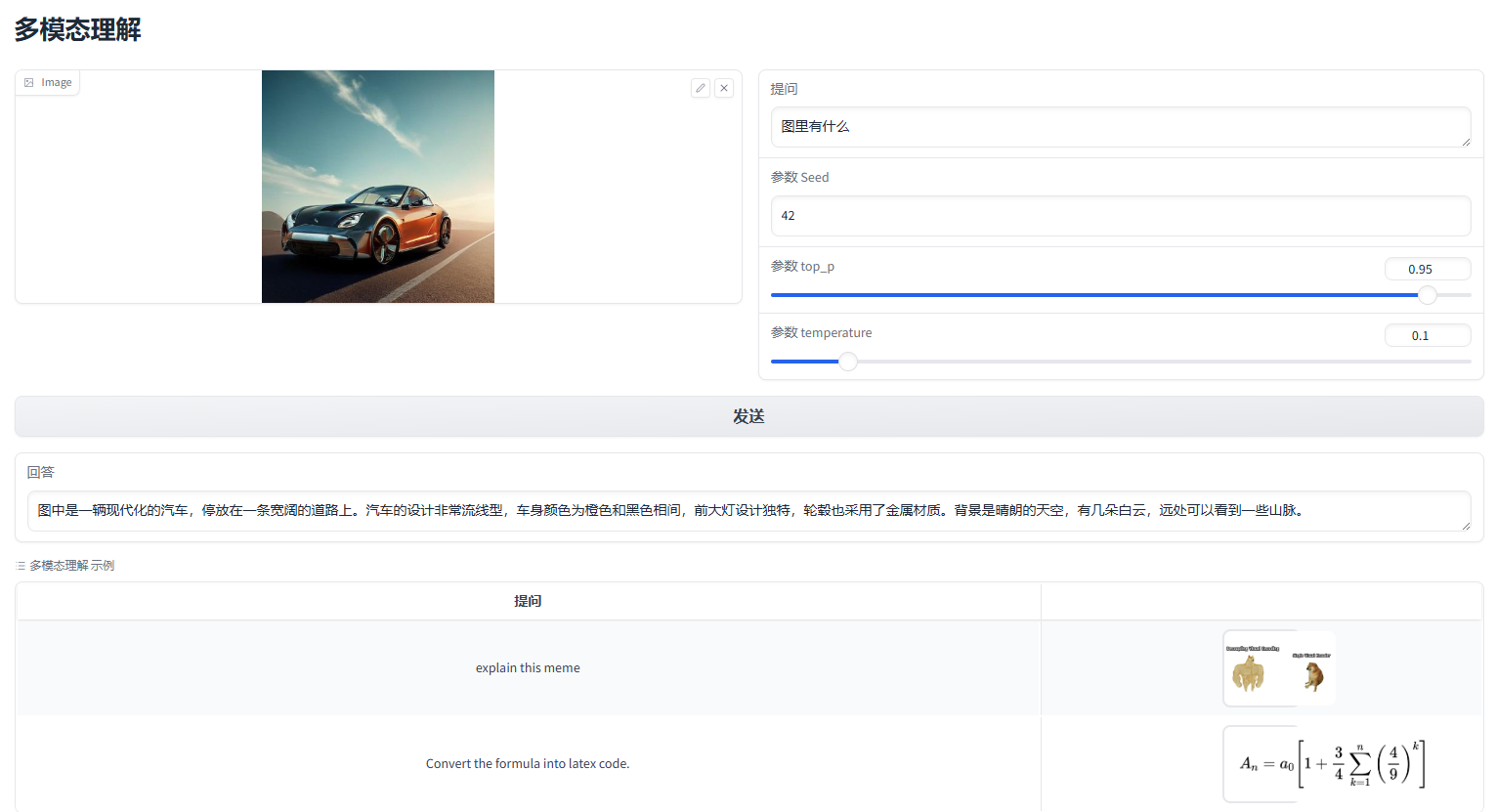
    gr.Markdown(value="# 多模态理解")
    with gr.Row():
        image_input = gr.Image()
        with gr.Column():
            question_input = gr.Textbox(label="提问")
            und_seed_input = gr.Number(label="参数 Seed", precision=0, value=42)
            top_p = gr.Slider(minimum=0, maximum=1, value=0.95, step=0.05, label="参数 top_p")
            temperature = gr.Slider(minimum=0, maximum=1, value=0.1, step=0.05, label="参数 temperature")

    understanding_button = gr.Button("发送")
    understanding_output = gr.Textbox(label="回答")

    examples_inpainting = gr.Examples(
        label="多模态理解 示例",
        examples=[
            [
                "explain this meme",
                "images/doge.png",
            ],
            [
                "Convert the formula into latex code.",
                "images/equation.png",
            ],
        ],
        inputs=[question_input, image_input],
    )

    gr.Markdown(value="# Text-to-Image Generation")

    with gr.Row():
        cfg_weight_input = gr.Slider(minimum=1, maximum=10, value=5, step=0.5, label="CFG Weight")
        t2i_temperature = gr.Slider(minimum=0, maximum=1, value=1.0, step=0.05, label="temperature")

    prompt_input = gr.Textbox(label="Prompt. (Prompt in more detail can help produce better images!)")
    seed_input = gr.Number(label="Seed (Optional)", precision=0, value=12345)

    generation_button = gr.Button("Generate Images")

    image_output = gr.Gallery(label="Generated Images", columns=2, rows=2, height=300)

    examples_t2i = gr.Examples(
        label="Text to image generation examples.",
        examples=[
            "Master shifu racoon wearing drip attire as a street gangster.",
            "The face of a beautiful girl",
            "Astronaut in a jungle, cold color palette, muted colors, detailed, 8k",
            "A glass of red wine on a reflective surface.",
            "A cute and adorable baby fox with big brown eyes, autumn leaves in the background enchanting,immortal,fluffy, shiny mane,Petals,fairyism,unreal engine 5 and Octane Render,highly detailed, photorealistic, cinematic, natural colors.",
            "The image features an intricately designed eye set against a circular backdrop adorned with ornate swirl patterns that evoke both realism and surrealism. At the center of attention is a strikingly vivid blue iris surrounded by delicate veins radiating outward from the pupil to create depth and intensity. The eyelashes are long and dark, casting subtle shadows on the skin around them which appears smooth yet slightly textured as if aged or weathered over time.\n\nAbove the eye, there's a stone-like structure resembling part of classical architecture, adding layers of mystery and timeless elegance to the composition. This architectural element contrasts sharply but harmoniously with the organic curves surrounding it. Below the eye lies another decorative motif reminiscent of baroque artistry, further enhancing the overall sense of eternity encapsulated within each meticulously crafted detail. \n\nOverall, the atmosphere exudes a mysterious aura intertwined seamlessly with elements suggesting timelessness, achieved through the juxtaposition of realistic textures and surreal artistic flourishes. Each component\u2014from the intricate designs framing the eye to the ancient-looking stone piece above\u2014contributes uniquely towards creating a visually captivating tableau imbued with enigmatic allure.",
        ],
        inputs=prompt_input,
    )

    understanding_button.click(
        multimodal_understanding,
        inputs=[image_input, question_input, und_seed_input, top_p, temperature],
        outputs=understanding_output
    )

    generation_button.click(
        fn=generate_image,
        inputs=[prompt_input, seed_input, cfg_weight_input, t2i_temperature],
        outputs=image_output
    )

demo.launch(,server_port=8000,server_name="0.0.0.0") #share=True
# demo.queue(concurrency_count=1, max_size=10).launch(server_name="0.0.0.0", server_port=37906, root_path="/path")

可修改Gradio interface设置中文
浏览器访问8000端口,